If you’ve been in marketing for more than five minutes, someone has told you that “links matter.” But how does link building help SEO in 2026, when search looks different every month and Google keeps rewriting the rules?
Let’s unpack it all in plain English, with examples and a few hard-won lessons from running real campaigns.
Two-Paragraph Answer for the TikTok Attention Span
Links help in four ways: they help Google discover pages, understand what those pages are about, evaluate their authority, and send actual humans to you who may search for your brand later.
Google says it uses links as a signal for relevance and discovery. It also has entire policies dedicated to stopping link manipulation, which is its roundabout way of saying links still move the needle when they’re earned and relevant.
Wait, didn’t Google say links aren’t a “top 3” factor anymore?
Yes, and we’ve talked about this before. In late 2023, Google’s Gary Illyes said people “overestimate the importance of links,” and that they haven’t been a top-3 factor “for some time.”
That doesn’t mean links don’t matter. It just means you can no longer win by simply collecting them like bottle caps. Content quality and intent satisfaction carry more weight today, but good links are still a durable edge.
Google’s own docs reiterate that links are signals for both discovery and relevance. If your pages aren’t linked, discovery lags, and context is thin. On the other hand, a natural reference from a strong, topically relevant page helps Google understand what your page should rank for and helps users decide you’re worth their time.
Large-scale correlation studies continue to find relationships between strong backlink profiles and better rankings. They’re not perfect causal proof, but taken with common sense and Google’s own documentation, they support a pragmatic view that strong, relevant links help you compete after content meets intent, especially in tough queries.
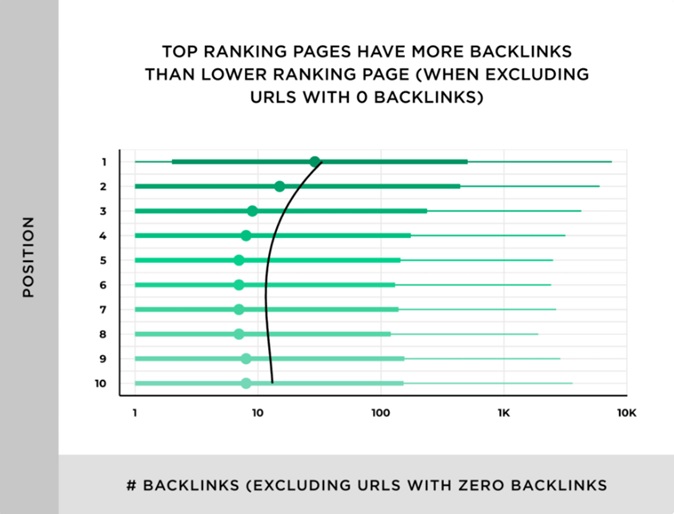
Source: Backlinko
Quality vs. Shortcuts
Over the last two years, Google has cracked down on abusive link-adjacent practices like site reputation abuse (“parasite SEO”), expired domain abuse, and scaled thin content. If a strategy exists primarily to borrow someone else’s domain signals or to manufacture signals, expect it to get hit.
There’s even been an EU antitrust complaint tied to how aggressively Google enforces that policy, which tells you how central this has become. The bottom line is that durable link building comes from editorially earned, relevant, human-read content, not rented domain authority.
Here are the four mechanisms you can actually measure to see how link building helps your own SEO efforts:
| Mechanism | What it does for SEO | What to measure | Notes |
|---|---|---|---|
| Discovery | Helps crawlers find new/updated pages faster | Crawl stats, time-to-index, log samples | Google says links help it find pages. Internal linking matters here, too. |
| Understanding | Adds context via anchor text and surrounding copy | Anchor diversity, topical alignment | Use natural anchors; don’t force exact matches. |
| Authority | Distributes “link equity” through the web graph | Referring domains, link quality, relevance | The original PageRank model is old, but the principle holds. |
| User Value | Sends qualified visitors who later search your brand | Referral traffic, branded queries, assisted conversions | Correlated with better rankings in aggregate studies. |
All that said, a decay problem that many people do not budget for is the fact that links disappear, pages die, and redirects break. This link rot is well-documented, too. Pew Research reports that 38% of pages from 2013 weren’t available by 2023, and legal scholarship has measured heavy reference rot in high-value citations. If you never audit, you’re leaking equity and credibility over time.
The Overlooked Half of Link Building
Before you chase anyone else’s links, fix your internal linking. Internal links are how you tell both users and Google which pages matter and how your topics connect. Google’s docs and long-standing guidance make it clear: good link architecture improves crawl coverage and helps prioritize important content.
If you’re linking to revenue pages from high-authority posts, you’re passing real equity. If those pages are orphaned, you’re leaving money on the table. A good play is to click through from your homepage to core pricing and customer stories in two hops or less, and to sprinkle contextual links from the blog to supporting resources.
Link Attributes 101
Not all links should pass ranking signals. Google introduced rel=”sponsored” and rel=”ugc” and treats these (and “nofollow”) as hints for evaluation. That means you should tag paid/affiliate links as sponsored and user-generated links as UGC, and keep nofollow for unvouched references. Doing this protects your site and clarifies intent.
| Link type | Typical use | Should it pass signals? | Attribute guidance |
|---|---|---|---|
| Editorial (natural) | Cited by an author because your page genuinely helps | Yes | No attribute |
| Sponsored / affiliate | Paid placements, sponsorships, affiliate programs | No | rel=”sponsored” |
| UGC | Forum posts, comments, community profiles | Generally no | rel=”ugc” |
| Unvouched | You don’t want to endorse or crawl it | No | rel=”nofollow” |
“If a link doesn’t send the right readers and teach Google something true about your page, it’s not worth placing.” — Bogdan, CEO at Tlinks
Think of link building as evidence. Each credible link is a footnote that says, “this page is useful for this topic.” Your job is to earn those footnotes from the right publications, structure your own site so those endorsements reach the right pricing and contact pages, and keep the whole system clean and compliant.
If you want a second set of eyes on your internal linking and a realistic roadmap for earning editorial links in your niche, reach out and ask for a quick link profile triage. We’ll show you what to fix this month and where the best opportunities are hiding.
Getting from Site Architecture to Provable Results with Link Building
All you need is a tidy site, a few assets people actually want to reference, and a way to earn coverage. Below is the exact sequence we use on real projects, including what to measure and where screenshots help a reader “see” progress.
Step 1: Build your internal-link blueprint first
Before asking strangers to link to you, make sure your own pages link to each other clearly, especially when you have a multilingual website. Internal links help Google discover and understand your content, and they help people move to the next useful page without friction.
Start with your homepage, primary money pages, and top supporting resources, such as case studies and reviews. Then, map contextual links between related articles and those revenue pages.
Quick internal link blueprint:
| Source page | Target page | Anchor snippet example | Placement guidance |
|---|---|---|---|
| Homepage hero or top nav | Pricing | “see plans” / “compare plans” | Keep it above the fold where possible |
| High-traffic blog post | Case studies | “how teams like yours did it” | Mid-article, after the first proof/data section |
| Comparison guide | Reviews/testimonials hub | “what customers say after 90 days” | End of guide + sidebar |
| Feature page A | Feature page B | “works with [feature]” | Within a short “related features” paragraph |
| Any article | The blog hub | “as seen in other articles” | Light footer text across articles |
Step 2: Pick assets that are actually link-worthy
People link to things that make their job easier, such as numbers they can cite, visuals they can paste, explanations that resolve confusion, and tools that save time. Pick one or two of these and go deep rather than trying everything.
Aira’s long-running “State of Link Building” surveys continue to find content-led link building near the top of what professionals actually do, which aligns with what works in the field when those assets have real utility.
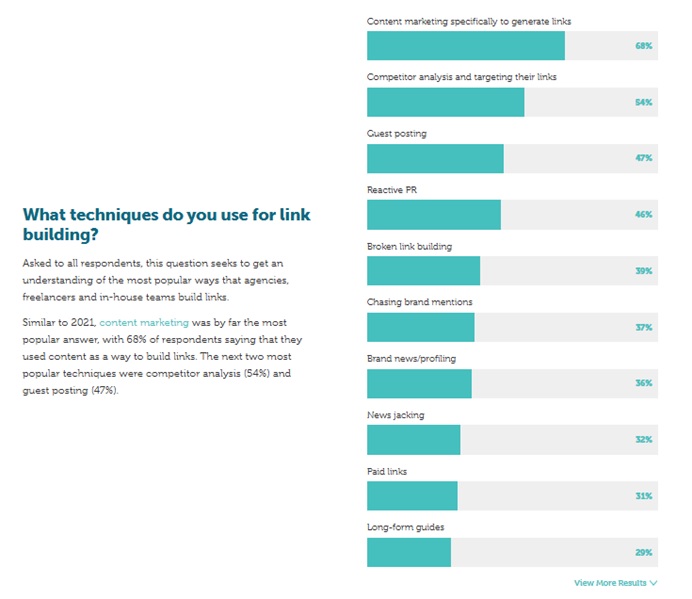
Source: Aira
Step 3: Calibrate your outreach so it earns coverage
Most cold emails are ignored. Backlinko’s large sample found only ~8.5% of outreach emails get a reply, so the default outcome is silence. But that’s not a reason to quit. Quite the opposite, actually. It just means you need to work on the quality of your outreach and change the timing, for example, through cold email automation.
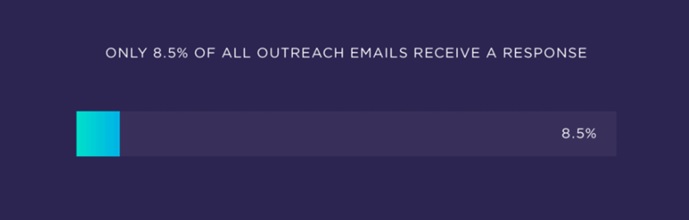
Source: Backlinko
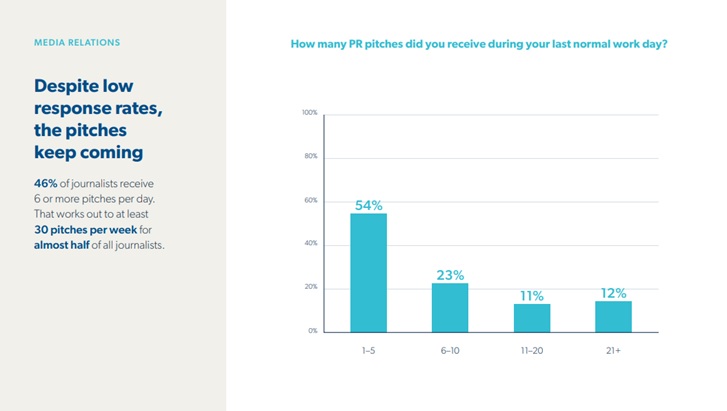
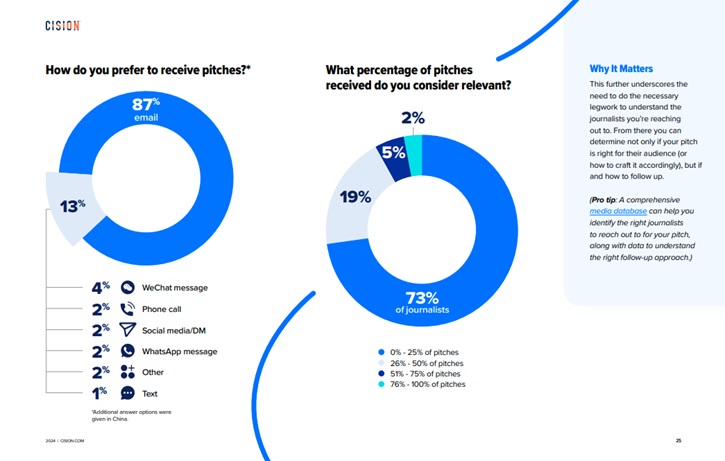
Journalists also say the number-one reason they reject pitches is irrelevance to their beat, and many receive 6+ pitches per workday. That means your list and angle matter more than your template. Keep it short and explain why their audience benefits.
“A takeaway that can’t be boiled down to a single chart is not a link asset; it’s homework. Make the ‘quotable’ bit obvious.” — Bogdan, CEO at Tlinks.io
Step 4: Keep it compliant and future-proof
Google’s infamous March 2024 update targeted patterns like site reputation abuse, expired domain abuse, and scaled thin content. If your plan relies on piggybacking on someone else’s domain equity with irrelevant content, expect enforcement. Keep your strategy anchored in editorial relevance and transparency, and respect link attributes when links are paid or user-generated.
Also, remember to use attributes like nofollow, sponsored, and ugc correctly. It keeps you safe and helps Google interpret the intent of a link.
Step 5: Reduce your cost per link by turning outreach into relationships
The most reliable links come from people who already know you. Here’s how you can begin acting like a source, rather than a spammer:
- Offer the chart, the CSV file, and a short quote that the reporter can use.
- Be useful even when the answer is “no.” Send a relevant stat or two anyway.
- Keep a simple “source profile” for each subject-matter expert on your team and refresh it quarterly.
Relevance, expert access, and ready-to-use data consistently rank at the top of what journalists say they want from PR contacts.
Source: Cision
Step 6: Route link equity to revenue
When a new high-authority site links to your asset, add two or three contextual internal links from that asset to pages that convert. Keep anchors natural, such as “compare plans” or “get a quick demo,” and ensure those target pages also link back to the asset where it’s helpful.
This closes the loop between authority and action, and it makes those editorial visitors more likely to stick around.
Final Thoughts
If there’s one takeaway from all of this, it’s that link building still helps SEO, but requires a bit more work than it perhaps did a decade or two ago.
Links serve four practical purposes at once: they help search engines find your pages, understand what those pages mean, weigh their importance against alternatives, and send real people who can become customers.
That power becomes evident when your house is in order, with strong internal links, your assets are genuinely helpful, and your outreach respects the reader, the publication, and the rules.
Shortcuts age fast, but relevance doesn’t. If a link wouldn’t make sense to a smart, skeptical editor, it’s probably not worth chasing. Treat links as evidence, citing credible sources that demonstrate your content addresses a genuine question, like most of the SaaS websites, eCommerce stores, and law firms are doing.
You don’t need a sprawling program to see results. Start with a one-page internal-link blueprint, ship one link-worthy asset a month, and run a tiny, perfectly matched outreach list. Keep the reporting human, connect wins to pricing, case studies, and reviews, and iterate.
Do that for a quarter and you’ll have a repeatable system you can show to anyone, including finance.