Trying to rank a local business too often results in the same loop: you make tweaks to the site, refresh the SERP, and stare at the same competitors, again and again.
In 2026, local link building still works — but you can no longer just collect backlinks like Pokémon and hope for the best. Instead, you need to build local proof through signals, not only that you exist, but that you’re trusted, and that real local entities are comfortable pointing people your way.
And local decisions are made fast. Research has found that 76% of people who search on a smartphone for something nearby visit a business within a day, and 28% of those searches result in a purchase.
This applies whether you’re a one-location shop or a SaaS with regional pages. So let’s see what you can do to get yourself seen.
Local link building in 2026: What has changed (and what hasn’t)?
Local link building remains about earning links from websites that are meaningfully connected to your geographic market, so you build credibility in that place. This means that, in practice, local link building is just local reputation made crawlable.
Typical sources are local institutions, local media, local communities, and local partners. A local-looking link that doesn’t count is a random directory that lists every business on Earth and exists mostly to sell you an upgrade.
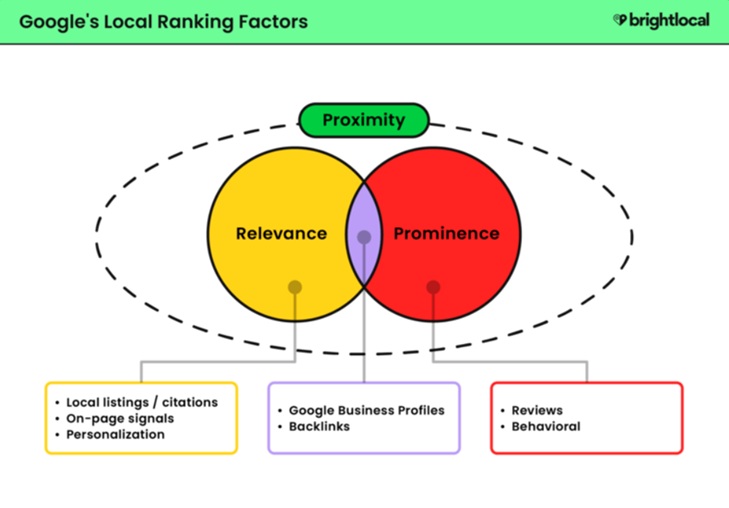
Google is pretty blunt about the fact that relevance, distance, and prominence (a.k.a. popularity) drive local search rankings and shape visibility across local search results, including Google’s local pack.
Distance is just physics. But you can influence prominence and relevance. Local backlinks are especially important for local pack rankings.
The former is essentially how much people talk about you, measured in links, mentions, reviews, press, and community references. Local link building improves local search engine rankings, and 42% of searchers click on Google Map Pack results for local queries. That’s why link building for local SEO is still one of the off-page plays with the most potential, as long as you aim it at real local trust, and not at vanity metrics.
What changed is how discovery happens. AI features, including AI Overviews, can show summaries with links to source pages. So, the 2026 win condition is to become the business that keeps getting cited across the local web.
What’s different for local link building in the age of AI
The main thing that changed is that local search is getting more opinionated. Instead of the good old 10-20 options per page, we increasingly see interfaces that summarize, shortlist, and link out.
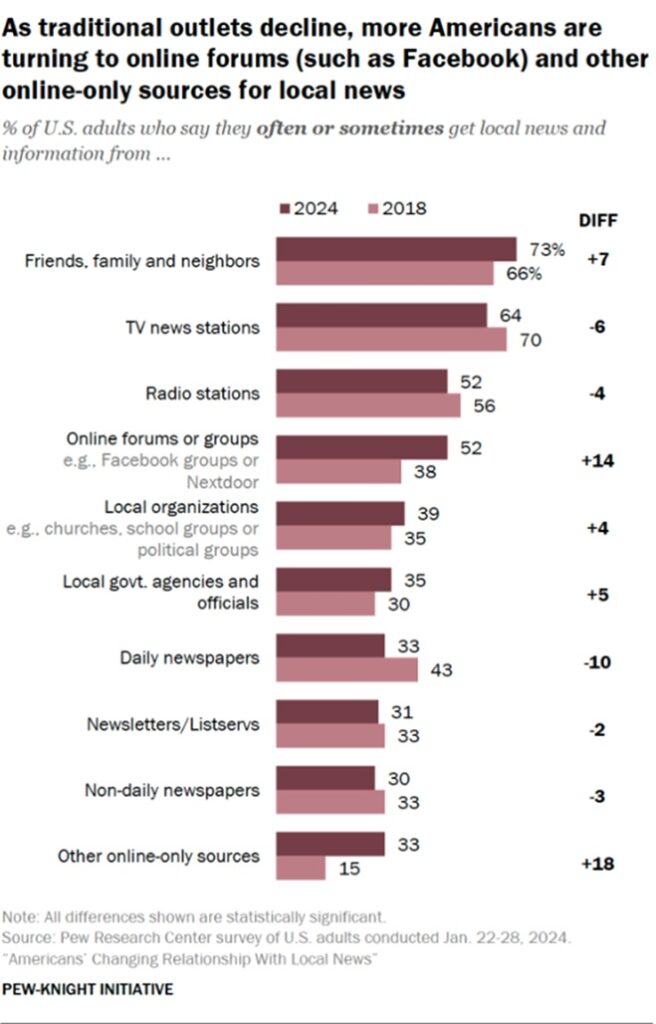
However, Google’s site-owner guidance has stayed pretty much the same: keep doing the fundamentals of crawlability, indexability, and usefulness well, and your content will be considered in these formats. That also means trust hubs remain a crucial player in local link building, because links and reviews work together as local authority signals that help search engines assess credibility. Almost half of US adults turn to local news outlets as sources for local business reviews, so that’s where the local traffic is.
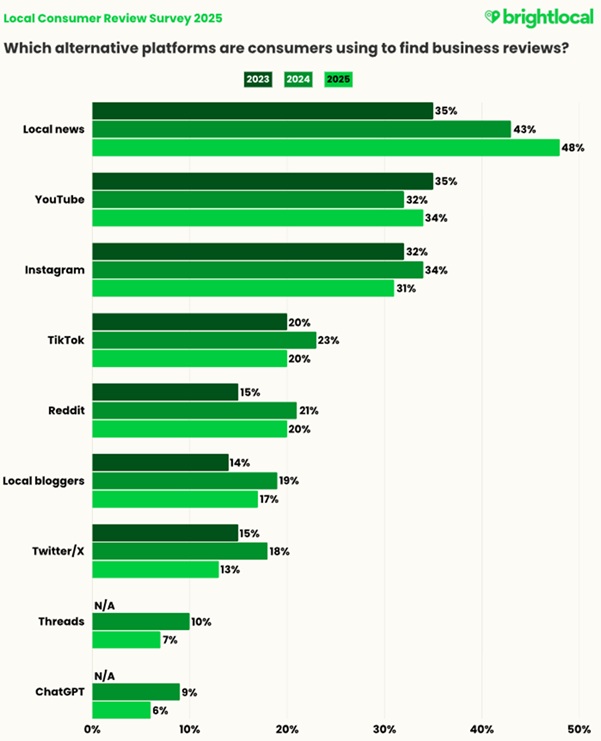
Source: BrightLocal
Reviews are the second most important factor for local pack rankings, and 88% of consumers prefer businesses that respond to reviews, which can further strengthen local authority.
Why many local link building efforts fail
Local link building strategies usually stall for one (or all) of these four reasons:
- You don’t have a page worth linking to. A homepage is not a linkable asset.
- You chase metrics instead of local relevance; high quality local backlinks from relevant local sources matter more than vanity DR wins, and a single high-quality local backlink can significantly boost rankings.
- You pitch like a robot, and local editors ignore it.
- You ignore your reputation layer.
A quiet blog is fine, but a boring site isn’t. If you publish one genuinely useful local page per quarter and build assets that attract quality local links from nearby organizations, you’ll usually beat any business that posts weekly fluff and still struggles to earn quality links.
However, when it comes to reviews, recency matters more than ever to consumers in 2026. Many people explicitly look for very recent reviews when deciding.
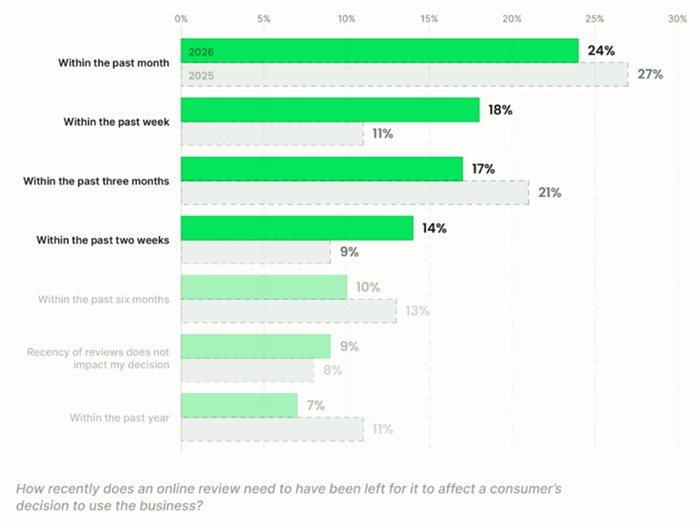
Source: BrightLocal
So, in theory, all you need to do is fix your basics, ship one or two proof pages, ask your customers/clients to leave reviews when they have a positive experience, and watch as your outreach gets dramatically easier.
In practice, that requires a bit of strategy and the right approach. We’ll deal with exact tactics in a minute, but first, let’s look at a few tools that will help you on your way.
The only stack of local link building tools you really need
When people ask about tools for local link building, we try to keep it simple. For most small local businesses, all you need is the basics: Google Search Console as a “truth source,” alerts on local newsletters and organizations as a way to spot mentions, tracking local citations in local directories, and a spreadsheet with prospects, contacts, and outcomes, as a way to track progress. Claiming listings also helps keep your business name, address, and phone number consistent. It’s also worth monitoring local business directories like Yelp and your local chamber of commerce for link opportunities.
Source: Google Search Console
But if you’d rather not build the whole machine from scratch, or want an outside set of eyes on your specific plan, feel free to reach out via the contact page, and we’ll be happy to help out.
12 local link building tactics that work
Below, we’ll cover the tactics that we’ve seen the best results from in the past, when it comes to building links for local businesses. Feel free to combine these with our best link building techniques and mix and match what fits your budget/goals.
Tactic #1: Start with one page for one local pain
Pick one problem your community tends to Google, and create the best local answer.
Essentially, what you’re aiming to do here is build a resource that people will reference because it saves them time. Something like a checklist, local timeline, decision tree, or specific locally oriented guide.
When creating these for our most satisfied clients in the past, we aimed for three things:
- Clear promise in the first paragraph
- One visual (even if it is a simple table)
- Section that makes the page obviously local (city-specific steps, local terminology, etc.)
Once it’s live, rather than “blasting” outreach, only seed it where it’s genuinely helpful, like in a neighborhood group resource list, on other local websites or local blogs, on a local nonprofit partner page, or to a community newsletter editor who covers the exact issue you’re trying to address.
This is foundational for link building for local businesses because every outreach email gets stronger when you have something genuinely citeable to point to.
Tactic #2: Turn partners into public references
Most local businesses already have relationships with suppliers, venues, complementary local businesses, and other local business owners that could translate into links.
To take advantage of this, explore your business associates’ websites, looking for “partners,” “vendors,” “recommended,” or “resources” pages. Then propose a tiny collaboration that makes the link natural.
For example, if you’re a wedding photographer, reach out to a venue to co-create a “timeline for a stress-free wedding day.” That kind of project can turn local connections into links from other businesses with a similar audience, while the venue could link to you as a recommended photographer and you could link them back as a recommended location.
The key is to keep it actually useful for the reader, rather than making it a blatant link-swapping exercise. Also, if money changes hands through sponsorships and paid placements, remember Google’s guidance to qualify those relationships appropriately.
For a broader framework when it comes to this style of outreach, feel free to borrow ideas from our link building strategies and just localize the targets.
Tactic #3: Win “who to call” pages
Many cities have pages that exist purely to answer the question of who to call for a particular problem. Neighborhood associations, HOAs, local organizations, local groups, community programs, apartment communities, and parent groups often maintain lists of trusted providers.
The play here is to make it easy for them to include you on these lists. Provide a short blurb, proof of licensing/insurance where relevant, and a URL to link to.
Our rule of thumb when it comes to this type of outreach is “two sentences and done.” One line should explain why you’re a fit for the list, and the other should offer a ready-to-paste description. If they need anything else, they’ll ask.
Local intent is high, and choices are made quickly, so being present in local resource lists creates strong local link building opportunities because those pages sit on trusted local websites.
Tactic #4: Pitch to local “best of” lists
These lists can be fluff, but they often influence local decision-making and local search rankings. Find lists that are actively maintained, and build a simple press-kit page with photos, 2–3 sentences, what you’re known for locally, and one linkable resource, plus any useful proof point like a chamber of commerce blog post or a local newspaper feature. When pitching, focus on an angle that helps their audience.
But before you do anything, if your reputation layer is weak, fix that first. And if you need help building a defensible local link roadmap, rather than a pile of random directory submissions, check out our pricing and see what a structured campaign looks like.
Tactic #5: Sponsor something real
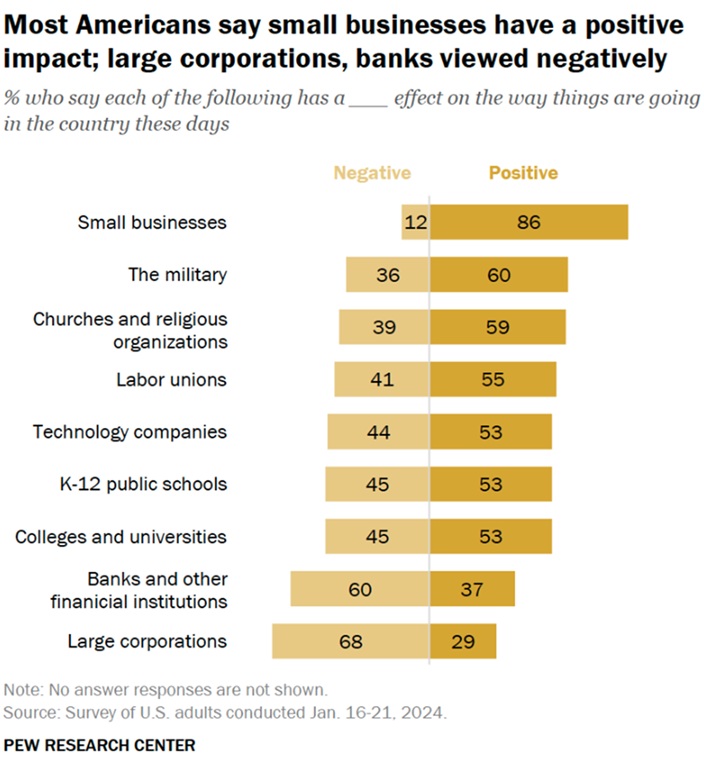
Local link building gets easier when you start thinking of yourself as a contributor to your community and deliberately sponsor local events. Pew found 86% of US adults say small businesses have a positive effect, and community involvement is naturally aligned with how people want to feel about local brands.
Source: Pew
So, rather than trying to slap your logo on every event page available, ask organizers to publish something useful that naturally includes you, like a downloadable route map or a “resources for attendees” page. Some sponsorships also create link opportunities on school or municipal sites, including .edu or .gov domains.
Make sure to keep it clean, too. Paid/sponsored links should be qualified to avoid sending manipulative signals. Don’t worry; even when a link is qualified, the right local events can still drive local media coverage, local visibility, brand searches, and references that support prominence in local search.
Tactic #6: Publish local data and pitch local media
Local news sites and local media outlets are starving for usable data, so you can gain a massive advantage by running just a tiny local study that’s easy to cite.
Examples that work well include seasonal price changes or before/after performance of a local initiative. Keep it transparent and clearly labeled when it comes to sample size, dates, and methodology.
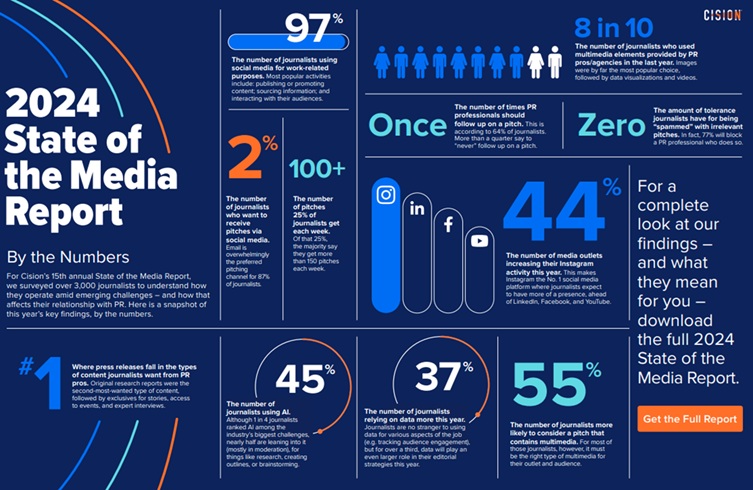
This pairs perfectly with PR-style local SEO link building because journalists prefer email outreach and lean on data more than ever, with 87% saying they prefer email pitches
Source: Cision
If you need distribution ideas, don’t discount digital outlets, local bloggers, news sites, and online community groups; local media is much more than just newspapers nowadays.
Source: Pew
That also means local news articles can turn into both links and brand mentions when your data gets picked up.
Tactic #7: Reclaim unlinked mentions and half-finished citations
This is the most boring tactic, which is why it works. Many businesses already have local mentions that never became links, like a charity thank-you page, a listing on the local chamber of commerce, a business bureau profile, meetup recap, or school newsletter.
Run a monthly sweep for your business name and address. The pitch, of course, is that you’re fixing a broken user experience, rather than asking for a favor. Basically, people are reading about you, but can’t click to verify. Fixing that helps the publisher as much as you. Links from local business associations boost local SEO authority, and a link from the local Chamber of Commerce can strengthen local authority even further.
This is link building for local businesses at its most practical, and it fits perfectly with Google’s local ranking idea of prominence being influenced by information and references across the web.
Source: BrightLocal
For the bigger picture, skim the benefits of link building and treat mention-reclamation as a low-hanging fruit to pick before moving up the tree with harder outreach.
Tactic #8: Broken-link building on local resource pages
Broken-link building sounds spammy until you realize how common broken links actually are.
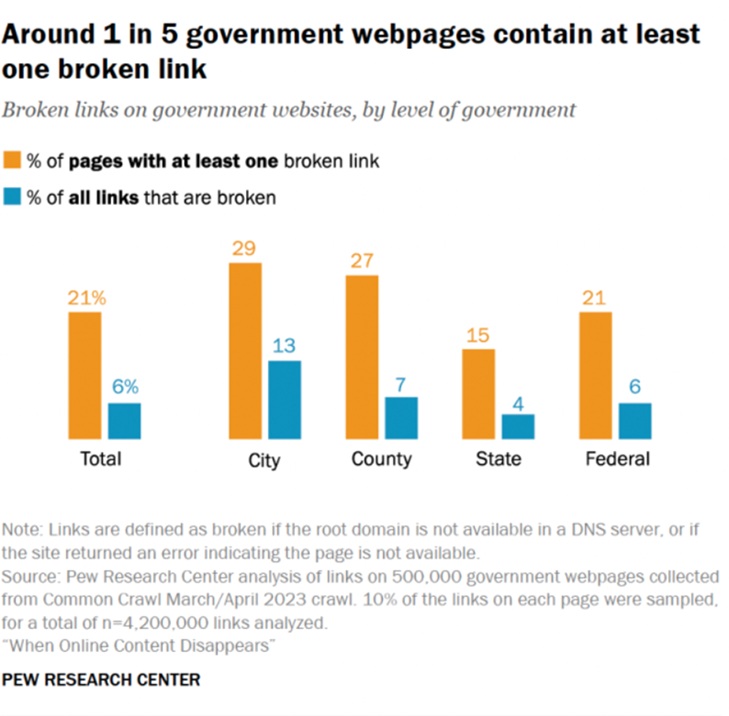
Pew’s analysis found 23% of news webpages contain at least one broken link, and 21% of government webpages do, too. Interestingly, local-level government pages are especially likely to have broken links.
Source: Pew
That’s your opening. Find local resource pages from libraries, city departments, neighborhood associations, and school PTAs, and curated, locally relevant local directories, and check them for dead links. Then offer a relevant replacement if you have a better page. Again, you’re helping someone fix their page rather than begging for a link.
Tactic #9: Create a local “recommended providers” page for others to copy
If your local niche is fragmented, when people search for “best ___ near me,” they end up bouncing between listicles and forums.
Make a page that organizes the local category without pretending you’re the only option. Pages like “How to choose a roof inspector,” “Questions to ask a family lawyer,” or “Checklist for choosing a physiotherapist,” need to include neutral guidance along with a short section comparing providers.
This feels counterintuitive, but it earns links because community sites don’t want to endorse one business; they’re much more interested in pointing to a fair explainer.
If you’re in professional services, make sure you’re compliant, and for legal specifically, build content that’s designed for link building for lawyers through local citations and bar/community references.
Tactic #10: Turn local expertise into local citations
References often start offline. Offer a short workshop to a community organization, library, or coworking space, or do a panel with adjacent businesses to help you find local groups and connect with a local audience. The event itself will get you seen, of course, but the local link building goal is the event page, recap post, speaker bio page, or resource page that follows.
Make it frictionless by publishing a clean speaker bio page on your site, along with a short resource page that matches the event topic. Then, after the event, send the organizer a recap paragraph with your correct name and URL that they can paste, and when relevant, share the event or recap through local Facebook Groups as well.
This tactic shines for link building for local businesses because it generates multiple natural references across different local domains without looking engineered.
Tactic #11: Build a library of local visuals
Creating visuals that other local sites can reuse is an overpowered tactic. This could be a seasonal maintenance calendar, neighborhood-by-neighborhood service map, price range chart, “what to do in an emergency” flowchart, or whatever works for your local community. Create it, and give it an embed code and clear permission to republish with attribution.
This is one of the few local link building strategies where you can almost predict outcomes. If the asset is genuinely useful, it is going to be reused. Build one great visual per quarter and you’ll feel the effect.
Tactic #12: Create locally focused comparison pages
Make a city-specific comparison page that helps someone choose between options in your local market and local area, and make sure the page reads like it was written by someone who has actually dealt with local reality.
This is especially powerful in AI-influenced search because it’s concrete and grounded, which is exactly the kind of thing that gets summarized and cited when users ask “what’s best in [city]?” and can also attract links from other local websites covering the same local market.
Which strategies for local link building to prioritize?
| If you are | Start with |
|---|---|
| New business with a thin footprint | #7, #3, #1 |
| Established business with lots of mentions | #7, #8, #6 |
| Service-area business | #12, #1, #8 |
| Professional services | #9, #10, #6 |
Whitespark’s 2023 study ranks local links as a top-three local ranking factor, which is why these priorities focus on building the strongest signals first.
Local link building in 2026: Wrap-up
Chasing the same ten directories your competitors hit in 2019 won’t get you far; focus instead on local business associations and other local businesses that are easier to reference in your community and make those references crawlable.
If you’re weighing local companies for link building SEO marketing, think about building local links with assets that relevant local sources across your market would want to cite, even if Google didn’t exist.
And if you want all the fundamentals in one place, we have an explainer on how link building helps SEO to use as a grounding doc for what should move the needle.