Whoever has tried multilingual link building knows that, no matter how strong your outreach and placement, Google sometimes just shrugs you off in certain markets. The reason is that you need more than Google Translate. In actuality, it’s closer to running several mini SEO campaigns that share a brand name and budget.
The good news is that once you stop treating languages like a copy-paste exercise, the results get a lot more predictable. This playbook pulls together multilingual link building best practices we’ve seen hold up across markets, plus what to look for if you’re comparing multilingual link building services or developing an in-house link building process for multilingual websites.
Main takeaways (read this if you’re busy):
- Multilingual link building relies on your technical setup routing authority to the right locale page.
- “Same keyword, different language” is usually the wrong approach; intent and context shift.
- Local relevance beats raw DR in multilingual campaigns more often than people expect.
- Hreflang mistakes waste a lot of hard work.
- The best strategies create reasons to cite you in each market.
- Reporting must separate global growth from per-locale impact, or you’ll optimize blind.
How much does multilingual link building matter in 2026?
The web isn’t mostly in English the way our SEO brains sometimes assume. Current usage data shows English at about 49.6% of websites where the content language is known, with Spanish and German each around 6%, Japanese ~5.1%, French ~4.5%, and Portuguese ~4.1%.
This matters because of what we know about buyer behavior. Across 29 countries, 76% of online shoppers prefer to buy products with information in their own language, and 40% say they won’t buy from websites in other languages.
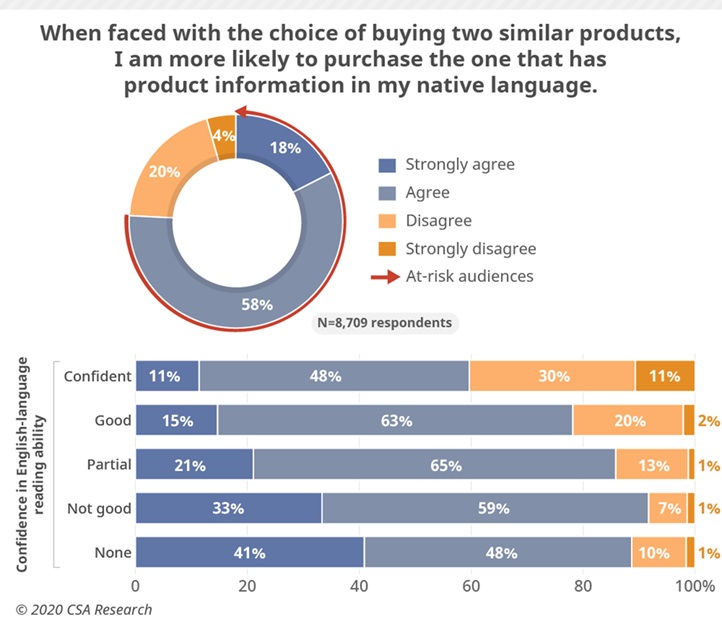
Source: Newswire
Language is a barrier even in cross-border shopping, with 21% of shoppers concerned about a lack of language translation, while as many as 72% of Japanese shoppers say they would not purchase from a website that isn’t in their own language.
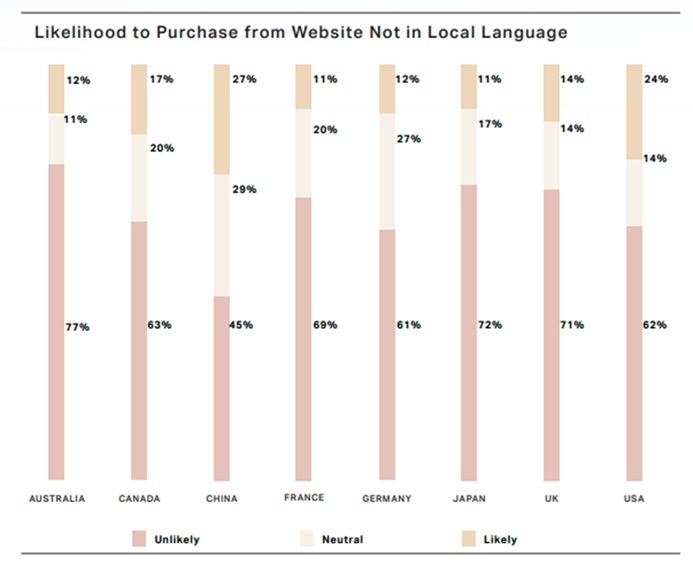
Source: FLOW
So where does multilingual link building come in?
Let’s illustrate it with an example. Say a German industry blog cites your German page. That sends multiple signals at once: authority (“this is worth referencing”), relevance (“this belongs in a German context”), and routing (“this URL should be the version search engines treat as the best answer here”).
You can think of multilingual SEO as having two gates.
- Gate #1 checks whether search engines understand and index your localized pages correctly.
- Gate #2 makes sure the web in that language can vouch for those pages.
Multilingual link building is how you pass Gate #2 without hoping translation alone carries you through. Here’s where multilingual links make a difference and how to measure it:
| What the link says | What it tends to improve | What you should watch |
|---|---|---|
| This brand is credible in our market | Topical authority in that language | Referring domains by locale |
| This page is the best local answer | Local SERP rankings | GSC clicks by country/language |
| This URL is the right version | Correct indexing/routing | Hreflang coverage + canonicals |
| Real people use this | Brand + demand capture | Branded queries per locale |
For a quick baseline before you go international, skim our guides to the best link building tools and link building strategies. They’re not multilingual-specific, but they’ll keep you from solving the wrong problems first.
And if you just want this aspect of business handled safely, check out our pricing page to see how we scope campaigns, and our contact page to tell us what languages you’re targeting.
Multilingual link building best practices: do this before you outreach
We could have opened this international link building playbook with outreach templates. But that would be like starting a road trip by picking a Spotify playlist before making sure your car has wheels.
The basics are boring, but they’re really where the magic happens. Below are the basics that we rely on for every project.
1. Pick markets you can win
The temptation is to start with a language list that sounds impressive, like Spanish, French, German, and Japanese, and build a global brand overnight.
But multilingual link building works best when you start with winnable markets in your target market and target country. That usually means you have enough demand to justify the effort, can produce content that doesn’t feel like a translation, and can gain traction faster by starting with less competitive keywords before going after more competitive keywords in a new language. With that, you can earn real local links, instead of just featuring on international sites that accept anything.
2. Map intent as well as keywords
Direct translation is how you accidentally target the wrong problem, because good keyword research has to reflect how people actually search in each market.
In one language, the “best” query might be a shopping shortlist, while in another, it’s a comparison. To get that right, you need to evaluate search intent against local search behavior and validate terms in the same language instead of translating from English. In some markets, the best linkable assets are long-form guides, and in others, your best bet is calculators, templates, and local directories.
Before you do multilingual link building at scale, you need a per-locale intent map. One page per language is enough, but really focus on what people ask, who they trust, and which formats get cited.
This is also why link building for multilingual websites fails when it’s too centralized. The outreach can be global, but the angles can’t, because the right terms shift across language markets, various languages, and different languages as each audience searches differently.
3. Be boringly pedantic about your hreflang and canonicals
Google’s documentation is clear on this. Google treats localized content as separate language variants when hreflang is implemented correctly. You can indicate alternate language/region versions via HTML, HTTP headers, or sitemaps, and each language version should reference itself and all alternates for the cluster to work. For sites in multiple languages, subdirectories are usually the practical default for new multilingual sites, while country-code top-level domains can strengthen SEO for established brands with country-specific operations.
Now pair that with the fact that 31% of international websites contain hreflang errors, and you see how quickly you can take the lead over a large chunk of global websites.
If your hreflang/canonical setup is in order, your link building strengthens the right version of the page. Otherwise, you just end up splitting signals across duplicates.
So, before you build links, run a technical pass. If you don’t, you’re paying to pour authority into a bucket with a hole in the bottom—and in international SEO and global SEO, that often means failing to serve the right target language version.
4. Local link ecosystems are not just the same site in another language
A mistake we see a lot is treating languages like folders in your CMS: create /de/, translate a few pages, then do the same outreach list-building you already do in English.
The problem with this is that each market has its own link logic. To compete in the local market, you have to account for how regional patterns differ across various language markets. Some countries have strong industry associations and member directories, while others lean on local media or niche communities. Some verticals have loud independent bloggers, and others are dominated by a handful of publishers who set the tone for everyone else.
If you want multilingual link building to compound, your goal is to become a familiar, cite-worthy entity inside the local ecosystem.
That means your prospecting filters change, since what counts as a trustworthy site shifts slightly by culture and niche. Your job is to map how that market decides what’s credible, then earn links inside that worldview. Monitoring competitors often reveals which local sites, high authority websites, and other link building opportunities already work there. When evaluating prospects or partners in each region, look for proven relevance, real audience fit, and strong multilingual capabilities.
5. Translation quality is only half the problem
We already mentioned that people are more likely to buy when they can read pre-purchase information in their own language, especially for higher-stakes purchases. So, when you’re doing eCommerce link building for multilingual websites, you should assume that the page you’re earning a link to needs to earn trust quickly in that native language, and that working with native speakers improves localization quality and avoids trust-killing mistakes.
That means:
- Localized proof: Local compliance mentions and local shipping/returns info if relevant
- Local examples: Not generic US-only references; use cultural references that fit the cultural context so the page feels genuinely local, not just translated
- Native-feeling UX patterns: Dates, currencies, units, and address forms
In practice, search engines prioritize content that feels native and relevant to the target audience in that market.
6. Site architecture + hreflang + internal linking can sabotage your wins
If you have multiple localized versions of a page, tell Google about them and keep that implementation consistent across multiple languages, because it also matters in regional search engines. Multilingual sites are messy, and pages easily get deleted or redirects get layered.
If you want a simple way to catch the dumb hreflang mistakes fast, Lighthouse has a dedicated audit that flags invalid language codes and shows what it’s detecting, which helps technical consistency support visibility in language specific search engines as well as any search engine.
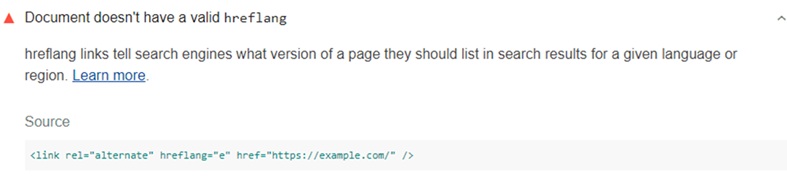
Source: Google
Multilingual link building tools that can boost results in 2026
Multilingual link building tools should reduce three kinds of failure:
- Prospecting blind spots: You miss the sites locals actually read.
- Outreach mismatch: You pitch like a foreigner.
- Technical leakage: Links land, but value doesn’t flow due to hreflang/architecture/internal linking.
Here are the best types of tools you can use to circumvent each of these potential issues:
| Tool category | What it’s for in multilingual link building | A common failure it prevents |
|---|---|---|
| SERP + competitor recon (per country/language) | Find what already ranks locally and who links to it | Building a global prospect list that’s irrelevant locally |
| Backlink + mention discovery | Spot local publishers, unlinked mentions, and reclaimable links | Missing easy wins because you only search in English |
| Site quality checks | Make sure a local site isn’t a ghost town | DR-chasing on dead domains |
| Outreach workflow + CRM | Keep language-specific campaigns organized | Confusing editors / duplicating outreach across locales |
| Technical audits (hreflang/internal linking) | Ensure alternates, canonicals, and routing are correct | Links work, but don’t help the intended locale |
Smart link building strategies for multilingual websites
Now that we’ve covered the basics with pre-prospecting considerations and tools, it’s time to explore some proven link building techniques that you can actually run if you’re link building for a multilingual website.
1. Building local-first linkable assets
Translated content is fine but often fails because it is culturally generic. The better play is to create content for the target audience in the target language, not just adapt existing pages, and to build one or two assets per market that feel like they could only have been produced by someone who understands that audience.
That approach helps you reach international audiences and improve search engine rankings because the assets reflect local realities. The simple truth is that most of your competitors won’t do the work, so you end up being the only source worth citing.
2. Expert seeding before outreach
Instead of blasting 200 cold emails in Spanish, find local consultants, professors, local influencers, or niche creators, and ask for a short quote or some local insight. Then embed those contributions in your asset and let contributors know it’s live. Local influencers often have established audiences in their communities, which helps build trust among followers and can lead to high quality backlinks.
This makes your content feel native and specific, and creates early distribution with a small cluster of local mentions/links that makes later multilingual outreach more credible.
3. Reclaiming links the market is already trying to give you
In multilingual campaigns, reclamation is often your highest ROI channel. This includes:
- Unlinked brand mentions in local press, especially on regional news sites
- Broken links pointing to old language URLs
- Citations that reference your product/company name but don’t link
- Outdated resource pages that can be refreshed with your newer localized content
Even nofollow links can be worth reclaiming for visibility, targeted traffic, and faster discovery of localized URLs.
We keep mentioning this strategy across our blogs because it works. And it’s especially powerful when your site architecture has changed (which multilingual sites tend to do), particularly when language-appropriate anchor text needs updating on reclaimed links.
4. Earning links through partnerships that locals already trust
Stop trying to be too clever for your own good.
Local chambers, trade associations, meetups, universities, NGO programs, and local directory listings often have sponsor pages, partner listings, case studies, or member directories. In many markets, those links are both trusted and topically relevant. Local directories can improve visibility, help search engines index your site, and support search engine rankings; in Germany, Gelbe Seiten is a useful example.
The key is to make the partnership real by, for example, sponsoring something small but legitimate, showing up around local events, or collaborating on a mini-report. You can also use local social media platforms to publicize the partnership in ways that fit the market. Credible guest posts on local blogs can also strengthen brand authority when they grow out of real collaboration. Social media helps reinforce that regional presence.
How Tlinks approaches multilingual link building services
We start by figuring out which locale in your target market will drive revenue soonest, which isn’t always the same as the one that will compound authority long-term.
Then we build a per-locale plan that includes a short list of linkable assets that make sense for that market, a prospecting map based on what already ranks locally, and a routing plan so links benefit conversion pages, plus a multilingual link building strategy and a measurable link building campaign for each market. The plan prioritizes quality backlinks, domain authority, and relevant local sites over raw volume, and some brands use a specialized link building service or external link builders to execute the campaign across other languages.
The results you should expect really depend on the market and the niche, as well as how ready your localized pages are. But a realistic timeline model may look something like this:
| Time window | Expected progress |
|---|---|
| Weeks 1–4 | Local SERP map, prospect lists, 1–2 localized assets planned |
| Months 2–3 | First local placements live, early ranking movement on long-tail |
| Months 4–6 | Stable velocity of local referring domains, noticeable SERP gains |
| Months 6–9 | Compounding: links start coming without constant pushing |
Conclusion: make multilingual link building boringly repeatable
In multilingual link building, relevance has more dimensions, including language, culture, local publishers, local trust signals, and technical correctness, and it supports better search engine rankings when relevance and technical signals align. If you do the unsexy stuff, like hreflang, routing, and localized UX, and build a few market-specific assets worth citing, so you can show up in the local ecosystem, you’ll be on the right track.
The trick is staying consistent with it for compounding gains. That’s how you improve search engine rankings across other languages and local markets over time, so multilingual becomes a growth engine instead of a never-ending translation chore.