If you’re on the lookout for link building strategies in 2026, you’ve probably noticed two things. First, it’s never been easier to publish content, and second, it’s never been harder to get that content trusted.
The web is loud, and SERPs are crowded with AI slop. Plus, you’ll inevitably run into tons of advice to “just write great content,” which is basically like telling someone to “just be taller,” with an SEO coat of paint.
So, this guide is about actual link building strategies that still work, earning real citations, surviving policy shifts, and avoiding shortcuts that age like milk.
We’re writing this as a team that has had to make many campaigns work for actual high-achieving businesses with very real timelines. That means we know all about impatient stakeholders and the fact that your founder cannot become a TikTok influencer just because it would help your links.
What Link Building Strategies Need to Work in 2026
The model we use is relatively simple: thinking of a link as a public receipt. Someone sees a thing you created and put out there and trusts it enough to reference it, and search engines and AI-driven systems read backlinks, citations, and similar trust signals as authority cues.
Google is actively trying to reduce manipulative linking, so that mental framing matters. The search engine’s spam policies are explicit that tactics meant to deceive or manipulate ranking systems can lead to pages, or entire sites, being ranked lower or removed from results, and they’ve continued tightening policy enforcement in recent years.
So your main question for 2026 shouldn’t be how to get more links. Instead, what you should really be asking yourself is how you can give actual publishers a reason to cite you and see you as a credible source reference. That means the definition of what link building is has changed in recent years, and strategies need to keep up.
Why Link Building Strategies Still Matter
Great pages slip into oblivion all the time because nobody discovers them, nobody trusts them yet, or both.
Links help with discovery, context, and confidence. Even Google documentation emphasizes crawlable links and descriptive anchor text so readers and search engines understand what a link is pointing to.
A Semrush ranking factors report shows a consistent relationship between higher rankings and stronger link metrics, like referring domains. It also contains one of our favorite lines in modern SEO: the median number of backlinks for top-ranking pages is 13 (even though the average is much higher). That’s your reminder that you don’t need an infinite number of links. For newer campaigns, a practical benchmark is at least 25-30 quality referring domains, since multiple links from the same domain carry less weight today than links from new referring domains. A handful of the right quality backlinks, earned consistently over time, is enough.
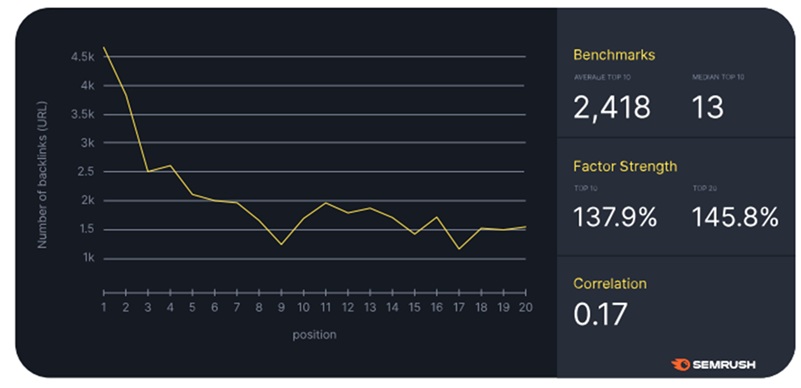
Source: Semrush
For a snapshot of what people in the industry are actually doing, BuzzStream’s stats roundup is packed with information, including this chart on which tactics people rate as most effective:
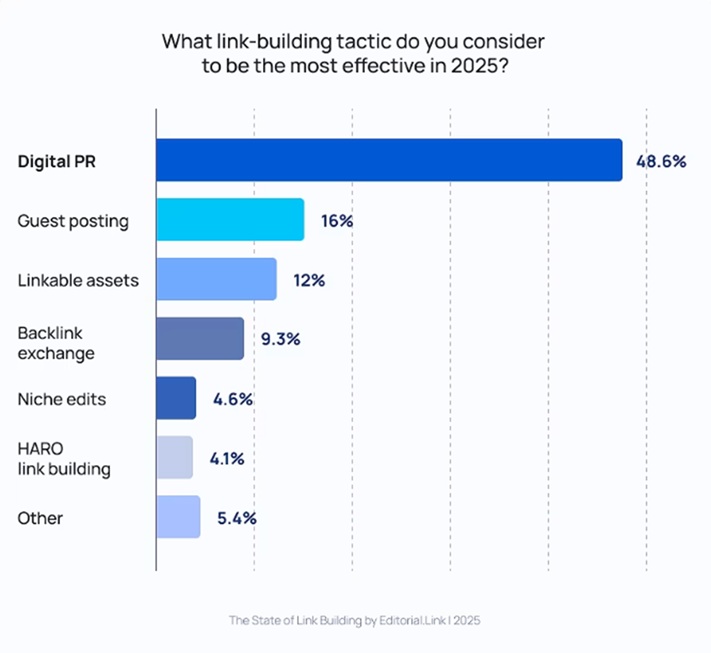
Source: BuzzStream
Finally, if you want the longer, mechanism-level explanation, covering crawl, relevance, authority, and referral traffic, we’ve already written extensively about how link building helps SEO and what to track when you’re not chasing vanity metrics.
Link Building in 2026: What Actually Changed
The strategies below would have worked in 2020. What changed is the environment around them: Google added two explicit spam policies in 2024, AI summaries now sit between the results and your page, and the volume of publishable content went up faster than the number of publishers willing to cite any of it. That is why advanced link building strategies now matter more at the margins, even though the fundamentals are stable. The tactics are stable. The tolerance for shortcuts is not.
- Site reputation abuse became policy, not interpretation. Renting space on a strong domain to host content unrelated to that site is now enforced against by name, which is what ended mass guest posting on high-authority generalist blogs as a repeatable play.
- Expired domain abuse got its own policy entry. Buying an aged domain to repoint its authority is finished as a strategy, whatever the vendor selling it says.
- Being the cited source now matters more than being the tenth result. With fewer clicks reaching the open web, original data, tools, original research, and primary reporting appreciate in value, while roundup content that only restates what others published depreciates.
- Scarcity moved from content to attention. Every editor you pitch is receiving more, better-written, more personalised-looking emails than they were two years ago. The differentiator is no longer the quality of the writing in your pitch — it is whether you are offering something they cannot get anywhere else.
What has not changed: editorial outreach, unlinked mention reclamation, resource pages, and internal linking work the same way they always have, but not all links help equally now, and relevance and authority matter more. That is the real answer to “what are the 2026 trends” — the newest thing in link building is how little tolerance is left for anything else.
Before You Start Pitching…
Most teams jump straight to outreach because it feels like progress, and we totally get it. Unfortunately, that’s also how you end up with 300 emails sent and nothing to show for it except a newfound hatred of subject lines.
A link building plan that works in 2026 starts with two decisions:
- Pick 3–5 pages that deserve authority. DO NOT build links for everything. Focus on pages that either convert or unlock a cluster of rankings once they gain trust.
- Decide what a reasonable publisher would cite in support of those pages, like a small, very specific, citable artifact that matches what the target audience and publishers actually need as relevant content.
This is also the moment to align internal links, so you direct link equity intentionally. This is one of the best link building techniques because it prevents all that newfound authority from immediately leaking out. And if you’re just building your stack, start with the best link building tools, so you’re not prospecting in 2026 like it’s 2013.
Finally, if you like the idea of link building, but would rather have a team of experienced pros handle it, say no more. Check out our transparent pricing and find the plan that works for you.
Link Building Strategies for SEO: Our 10 Favorites (and a Bonus)
These are the best link building strategies we keep coming back to because they create content people want to reference and respect the reality that Google is fighting manipulation.
1. Original-data digital PR
If you want links from sites that would never accept a guest post, aim for editorial links by giving publications something they can’t get elsewhere: a new number.
The key is to start thinking in patterns, with original research as the preferred format for these campaigns. Pull anonymized trends from your product (even if it’s just support tickets or feature usage), analyze a public dataset, or benchmark a niche journalists cover but rarely quantify.
Then make it easy to cite. Strong original research can attract citations from journalists and, in standout cases, generate thousands of backlinks from many domains, including news sites. You need just one clear chart and one surprising takeaway. Done right, this stops your outreach from feeling like begging and turns it into a helpful offer.
2. Unlinked mention reclamations
This one feels like cheating, which is why it works. If someone already gave you brand mentions, named your founder, your tool, or a unique term you coined, you’ve already done the hardest part: being worth naming.
Brand Monitoring tools help you find unlinked mentions quickly.
Your job is to thank them with a warm, appreciative pitch and ask if they could link the mention so readers can find the resource. This helps you, improves their article, and unlinked brand mentions can often be converted into backlinks with some of the easiest link wins.
As link building strategies go, this is one of the easiest link building strategies to start with.
3. A “source of truth” page
A lot of content tries to rank, but a source page tries to get referenced, much like a resource page.
Pick a narrow topic where people routinely need to cite definitions or standards, and where most existing results are outdated or thin. Then build one page that is clearly the best citation on the topic, with statistics pages being especially strong when people need a number to cite, and keep it maintained so it becomes link worthy content publishers can reference repeatedly.
4. Linkable tools and calculators
If your niche has decisions people hate making that involve pricing, sizing, compliance, or comparisons, focus on creating valuable content by turning the decision into a lightweight calculator or interactive checklist.
It doesn’t need to be fancy. It just needs to be accurate, relatively fast, and easy to reference. A helpful tool that resolves a dilemma will attract links in a way that pure text rarely does. Tools and calculators also work well as link bait because they solve a practical problem people want to reference. Even international brands are using this strategy.
If you want a few examples of link-led growth, browse our case studies.
5. Refreshing “decayed” pages and winning new citations
One sneaky reason link building strategies fail is that the page you’re building links to isn’t as strong as you think anymore.
That ultimate guide you wrote back in 2021 looks ancient now. And once a page stops feeling current, editors stop citing it, even if it used to be good. Websites lose roughly a quarter of their links every seven years, which is why reclamation matters.
So pick one target page and do a full refresh: update the year, replace outdated examples, add two new sections that solve new problems, and tighten the first 200 words so it clearly earns the click. You can use Semrush to find lost backlinks to your domain. Check whether the page with the lost link is still live before outreach and, if it is, email site owners politely to restore the dropped link.
Then reach out to people who linked to similar (now outdated) resources and show them the updated version, because refreshed pages deserve renewed citations that can improve organic search results. Link rot is common enough that editors expect replacements; a Pew Research study found broken links are widespread across the web, including news and government pages.
On that note…
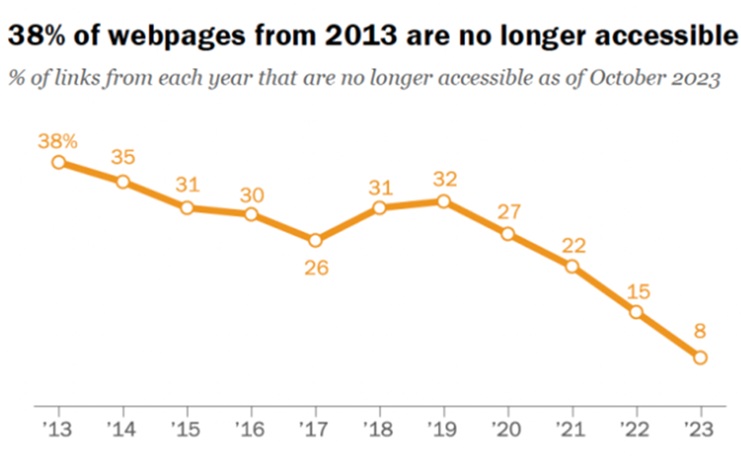
Source: Pew Research
6. Replacing dead resources
Broken-link building got a reputation because lazy people turned it into spraying 1,000 sites with the same template. The modern version that actually works is smaller, cleaner, and more useful because it helps publishers fix dead links, not just swap URLs.
Start with a specific topic where a lot of older pages cite the same resources, such as studies, PDF reports, and old tools. Use tools to find broken links and surface missed prospects, especially links pointing to pages that no longer exist. And when you find a dead reference, immediately pitch the fix:
- Show them the exact dead URL
- Offer a replacement that’s genuinely equivalent (or better)
- Keep the email short enough that a human will actually read it
This works especially well when the replacement is a maintained “source of truth” page or a rehosted summary of a disappearing resource (with proper attribution) on authority sites.
7. Journalist requests
If your link building strategies rely on guest posting alone, you’re trying to be heard in the noisiest room in the building. It’s possible if you’re really loud, but your voice would travel much further in a quieter room. That’s where journalist request platforms, inbox queries, and editorial research calls come in, helping brands land placements on authoritative websites. The core mechanic is simple: reporters need credible answers, as shown by the fact that Muck Rack’s State of Journalism 2025, with insights from 1,500+ journalists, lists disinformation and misinformation as the biggest threat to the future of journalism.
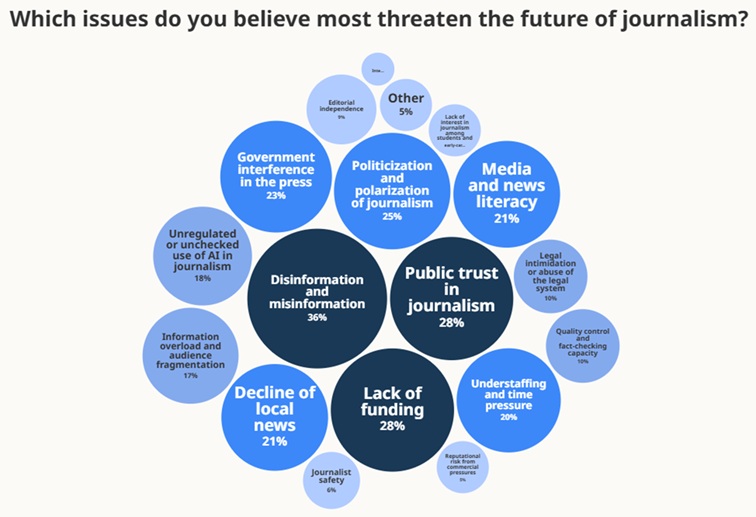
Source: Muck Rack
So, prepare 3–5 ready-to-quote mini angles with a credential line and a viewpoint you can defend. Then respond quickly and clearly when the request matches. If you’re helpful, the link tends to show up naturally in the citation or attribution on high authority websites.
8. Integrations and partnerships
This is the most underused category of link building strategies because it feels like business development rather than SEO in the traditional sense, yet it can also help you build relationships that support future outreach.
Here’s what it’s all about: if your product or service connects to anything, like a tool or platform, there are usually public pages on relevant websites that list partners, compatible providers, or recommended resources. Those pages exist to help their users, so a link is a feature, not a favor.
The play is to create a tight integration/compatibility page (even if it’s just “how we work with X”), then reach out to the platform/community to be included in their directory or partner list.
As a bonus, these links don’t just improve your DA/DR; they can become valuable links that send real referral traffic because they appear at the exact moment someone is trying to choose a solution.
9. Clever visuals
Give a writer a chart that explains something in 5 seconds, and they’ll cite it in blog posts.
For the best results, create a small set of original charts. Pick one industry trend, one comparison, and one process diagram or infographic, and publish them on a page that explains the methodology. Then allow editorial reuse with a simple embed snippet or clear reuse guidance so the asset can generate links.
Visually appealing infographics can attract significant backlinks when they are easy to understand and reuse.
This pairs nicely with the original data PR approach from Strategy #1, but you don’t need a full report. Sometimes one clean chart is enough.
10. Real-world participation
This one boils down to a simple instruction: do something real in legitimate industry spaces and make it easy for organizations to reference it, which can naturally lead to community links.
That could mean sponsoring a niche event or contributing a resource to a community that already has standards. Then, instead of asking for a link directly, you give them a page that helps them tell the story for other websites (agenda, speakers, recap, resources) and make it easier to secure links.
Bonus: Aligning with spam policies and avoiding “link scheme” footprints
Google is explicit that violating spam policies can lead to demotion or removal from search results, and they describe both automated detection and manual actions.
So, as you scale link building strategies, avoid patterns that look like paid links, mass templated outreach, or unnatural exchanges, including networks built around selling placements across entire websites. Not all links are worth pursuing if they create obvious scheme footprints. If a tactic would look embarrassing in a screenshot, it’s probably not the hill to die on.
Outreach and Prospecting Strategy
Every strategy above eventually becomes an email to a stranger, and that is where most programs quietly fail.
Prospecting decides whether the email has any chance before you write a word of it, which is why a short, ruthlessly filtered list beats a long one every time.
- Build the list from pages, not domains. Pull the sites linking to the pages currently ranking for your target query and analyze the pages on other sites that already link to comparable content, rather than to competitor homepages. The result is shorter, more relevant, and made up of publishers who demonstrably link to material like yours. Competitor backlink analysis can reveal link opportunities you would miss if you only looked at top-level domains.
- Cut the list before you write anything. Delete every prospect that would never plausibly link to you, however strong the metrics look, and make sure you can identify the right website owner or editor before the list survives. Twenty real candidates convert better than two hundred that were never going to reply.
- Lead with the thing, not the ask. The first sentence should contain what you are offering. Editors decide in about two seconds, and an opening paragraph of pleasantries spends that budget on nothing, even though personalized outreach messages increase response rates by 20-30% and direct outreach often lands in the 10-20% range when the fit is strong.
- One follow-up, with something new in it. A second email that repeats the first is noise. A second email with a different angle or an additional data point occasionally works, and one follow-up can improve response rates by around 30%; anything past that damages a relationship you may want later.
Anchor Text and Link Placement Strategy
Anchor text is the one part of an earned link you can sometimes influence and should mostly leave alone.
A natural profile is varied — brand names, URLs, partial matches, and ordinary phrases — because that is what real editors produce when nobody is coaching them.
- Suggest, never dictate. If a publisher asks what to link, give them a descriptive phrase that fits their sentence. Sending an editor a required exact-match anchor is the clearest signal available that the link is transactional.
- Placement inside the body beats everything else. A link in a relevant paragraph is worth several in an author bio, a footer, or a resource block bolted onto the end of a post; the best version sits inside a relevant linking page with real context.
- On buying placements: paying for a followed link to influence rankings is what Google’s spam policies describe, and the only compliant version is a sponsored or nofollow attribute — which is to say, the version that passes no ranking credit. Informally, people call the value passed by followed external links link juice. If a vendor is selling followed placements at a per-link price, you are buying the risk, not the link.
- For guest contributions, one contextual link to a genuinely relevant resource is the safe pattern. Multiple keyword-rich anchors pointing at commercial pages is the footprint that makes an otherwise fine article look like a placement.
When to Run Link Building Campaigns
Link building is not seasonal in the way retail content is, and the best time to start is almost always now, because the compounding starts on day one and nothing about waiting improves the outcome.
Timing matters for individual pitches, not for the program.
- January and September are the two easiest windows for data pitches. Editors are planning the year or the autumn quarter and are actively looking for numbers to build stories around. A report published into that planning window gets read; the same report in mid-December does not.
- Q4 is the hardest quarter to earn coverage and the easiest to earn partner links. Journalists are buried in seasonal coverage, but marketplace listings, directory placements, and integration pages have no seasonality at all. Shift the effort rather than pausing it.
- Pitch the calendar your industry actually keeps. Compliance deadlines, conference dates, regulatory changes, and reporting seasons are all predictable months in advance, and being early to a date everyone else remembers late is the cheapest advantage in outreach.
- Do not stop and restart. A program paused for a quarter loses relationships, not just links. Warm contacts go cold, and the next campaign starts from further back than the last one finished.
Keep Yourself Honest With Link Building Strategy Measurements
There’s a lightweight way to gauge whether your link building strategy is working without getting lost in vanity metrics with measurement focused on quality links, not just counts. Here’s a table for a simple overview:
| What you measure | What it tells you | What a good result looks like |
|---|---|---|
| Referring domains to target pages | Authority growth to money pages | Steady monthly increase, not spikes; domain authority can help as a secondary check, not the goal |
| Link relevance (topic + page context) | Whether links fit | Most links come from the same topical neighborhood |
| Traffic from linking pages | Human value, not just SEO | Some links send organic traffic, visits, and conversions |
| Indexation + ranking movement | Search impact | Gradual lift after consistency (weeks/months) |
| Risk flags (paid footprints, sameness) | Future update pain | Low pattern repetition; diverse sources |
Also, if you do sponsor placements or paid ads, Google recommends qualifying those outbound links (e.g., rel= “sponsored”). But even if you’re mostly earning links, knowing the rules keeps you from accidentally stepping into the link scheme zone and getting on Google’s bad side — while keeping audits and link hygiene under control on your own site.
Link Building Strategies: Conclusion
The best link building strategies in 2026 aren’t tricks. They’re effective link building strategies built on systems for earning citations as part of a broader content marketing approach: publish things worth referencing, show up where editors already gather information, and keep your core pages fresh enough to deserve the high quality backlinks you’re chasing.
If you want to see what this looks like across real campaigns, Tlinks is here to help you. Just send us a message.